01
Clearer operational decisions
Bring asset, work, weather, market, and sensor data into tools that help teams understand conditions and choose the next action.
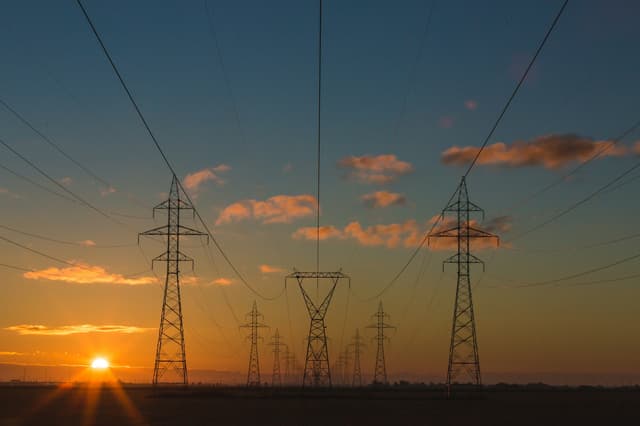
Energy & critical infrastructure
We build AI, data, and operational products for energy organizations where fragmented information, physical assets, and critical decisions meet.
Operational value / 01
Energy systems combine long-lived assets, changing demand, field operations, multiple data sources, and high reliability expectations. We build digital capability around those realities, connecting information and workflows without treating critical operations like a consumer app experiment.
01
Bring asset, work, weather, market, and sensor data into tools that help teams understand conditions and choose the next action.
02
Design integrations, observability, fallback behavior, and human control for systems expected to work under real operational pressure.
03
Apply forecasting, anomaly detection, document intelligence, and assistants where performance can be measured and limitations managed.
What we deliver / 02
We work across planning, field execution, asset performance, customer operations, data foundations, and the safe application of AI.
/01
Combine operational and maintenance data to improve visibility into asset condition, performance, anomalies, and intervention priorities.
/02
Build decision-support tools for demand, generation, storage, scheduling, and resource planning with uncertainty made visible.
/03
Give field teams reliable mobile and web workflows for inspections, work orders, evidence capture, coordination, and escalation.
/04
Integrate telemetry, asset, customer, market, and enterprise data with clear ownership, quality controls, and usable interfaces.
/05
Support engineering and operations teams with grounded knowledge, document analysis, workflow assistance, and bounded automation.
/06
Design security, resilience, evaluation, observability, and governance around the consequence and operating context of each system.
How we deliver / 03
Useful energy technology starts with the decision, asset, user, and consequence, then works back to the data and system design.
01
Map the operational workflow, asset context, users, data sources, constraints, and consequences of failure.
02
Test the value case and technical assumptions against representative data and real operating conditions.
03
Build the product, data flows, integrations, controls, and fallback behavior as one dependable system.
04
Measure operational performance, data quality, user adoption, model behavior, and reliability after launch.
Questions / 04
Useful areas include demand and generation forecasting, predictive maintenance, anomaly detection, asset inspection, engineering knowledge retrieval, scheduling, customer operations, permitting support, and analysis of operational documents and sensor data.
We define the intended decision, acceptable error, representative conditions, edge cases, human review, fallback behavior, latency, security, and monitoring before judging whether an AI approach is suitable.
Yes. Many energy programs require incremental integration with existing asset, work management, telemetry, GIS, ERP, and reporting systems. We map interfaces and dependencies before choosing whether to integrate, wrap, modernize, or replace.
Field workflows can be designed for intermittent connectivity through local state, controlled synchronization, clear conflict handling, and visible status so users know what is saved, submitted, or awaiting connection.
Yes. We support utilities, renewable developers, infrastructure operators, energy service companies, and technology providers, adapting the delivery model to operational context and organizational maturity.
Start with the real problem
Tell us which teams, assets, data, and systems are involved, and what reliability means in that environment. We will define the smallest credible intervention.
Talk to KeshoLet's build / 05